The Connection Between Eye Health, Liver Function, and Gut Health
The Relationship Between Eye Health, Liver Function, and Gut Health
The body functions as an interconnected system, where symptoms in one organ or bodily system are often related to imbalances elsewhere in the body. Therefore, eye problems are not viewed solely as localized issues of the eyes themselves but may also be indicators of underlying imbalances involving the liver, the gut, or metabolic processes.
The Liver as a Key Organ
The liver plays a central role in detoxification, fat metabolism, hormone balance, and the storage of essential nutrients. From an orthomolecular perspective, an overburdened liver may lead to reduced processing of waste products and increased strain on other systems within the body.
In addition, the liver is involved in the conversion and storage of nutrients that are essential for eye health, including vitamin A. A deficiency or reduced availability of these nutrients may manifest as symptoms such as dry eyes, eye fatigue, blurred vision, or impaired adaptation to low-light conditions.
Gut Health as the Foundation
Within orthomolecular medicine, the gut is considered one of the most important foundations of overall health. An imbalance in the gut microbiome, increased intestinal permeability ("leaky gut"), or chronic intestinal inflammation may impair the absorption of vitamins, minerals, and antioxidants.
Furthermore, pro-inflammatory substances may enter the bloodstream from the gut, which, according to this perspective, can contribute to inflammatory processes elsewhere in the body, including the eyes.
The Gut–Liver–Eye Connection
Within a holistic approach, a functional connection is often recognized between the gut, the liver, and the eyes. When the gut microbiome becomes imbalanced, the burden on the liver may increase. Reduced liver function can subsequently affect nutrient availability and the body's ability to help reduce waste products. Over time, this may manifest in a variety of symptoms, including eye-related complaints.
What is leaky gut and how do you fix it?
In our bodies, the intestinal lining plays a crucial role in absorbing nutrients and protecting against harmful substances.
But what if this intestinal lining becomes damaged?
This phenomenon is known as "leaky gut" and can lead to various health problems.
Leaky gut or increased intestinal permeability, is a condition in which the lining of the intestinal wall becomes damaged and overly permeable. This allows harmful substances—such as undigested food particles, bacteria, and toxins—to enter the bloodstream and spread throughout the body. This can lead to an overreaction of the immune system, inflammatory responses, and even autoimmune diseases.
The intestinal wall consists of a single layer of cells tightly packed together, interconnected by protein complexes called tight junctions (see Figure 1).
These cells are covered with microscopic projections called villi and microvilli, which increase the surface area of the intestinal wall and aid in nutrient absorption. The tight junctions regulate the permeability of the intestinal wall. They help selectively allow nutrients to pass through while keeping unwanted substances out.
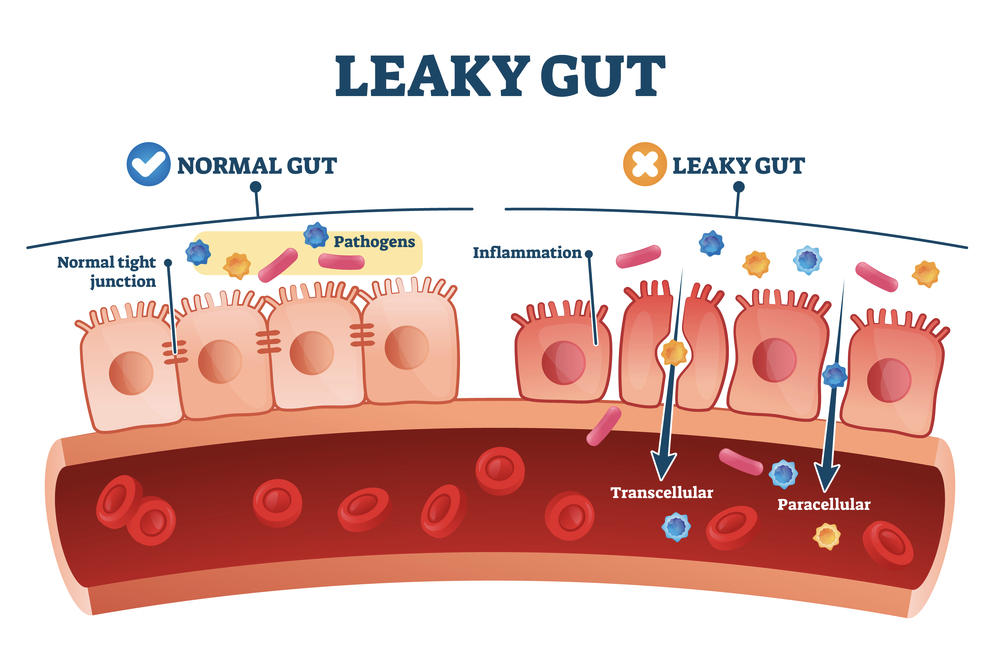
Figure 1: Illustration of leaky gut
In leaky gut, several factors are responsible for disrupting the tight junctions, namely:
* Food intolerances; such as gluten, lactose, eggs, soy, fish and shellfish, nuts,
peanuts, and nightshade vegetables.
* Chemicals; such as alcohol, nicotine, medications, plastics, toxins, heavy
metals, and pesticides.
* Stress; whether physical, psychological, chronic, or emotional.
* Poor nutrition; such as processed foods, refined sugars, sweeteners, additives,
preservatives, seed oils, and processed meat.
* Imbalanced intestinal flora; due to, among other things, candida, SIBO, or
antibiotic use.
Leaky gut symptoms:
A leaky gut can be the cause of many health problems. Leaky gut symptoms include:
* Intestinal complaints: abdominal pain, cramps, bloating, gas, diarrhea, or
constipation.
* Food intolerances: inability to tolerate foods such as gluten, dairy, soy, eggs,
and nuts.
* Skin problems: acne, eczema, psoriasis, or other forms of skin irritation.
* Allergies and asthma: increased intestinal permeability stimulates the immune
system and thus the development of allergic reactions and asthma.
* Mood and cognitive problems: anxiety, depression, as well as problems with
concentration and memory.
* General inflammatory responses: An increased systemic inflammatory
response can result in fatigue, headaches, muscle and joint pain.
Why probiotic with Leaky gut?
Probiotics are crucial for leaky gut because they restore and strengthen the intestinal barrier by combating harmful bacteria. They improve gut flora, reduce inflammation, and support resilience against toxins and undigested food particles from entering the bloodstream through the intestinal wall.
Important functions of probiotics for leaky gut:
- Intestinal wall repair:
Probiotics help repair the intestinal mucosa.
- Intestinal barrier strengthening:
They help close the tight junctions (connections between intestinal cells).
- Microbiome balance:
They inhibit the growth of harmful bacteria and increase the population of beneficial
bacteria.
- Reduced inflammation:
They contribute to calming the immune system in the gut.
Why use Probiotic Maxilin
Maxilin is a natural probiotic based on live acidophilic lactobacillus (strain No. 2585). The bacterium fully restores the intestinal microflora, killing putrefactive, pathogenic, and other harmful microorganisms.
This is the only product resistant to all types of antibiotics!
Antibiotics are present in products (especially in meat, eggs, fish and milk products) — they are widely used in the food industry — and in fact, after a short time, most of the beneficial microflora will be killed by antibiotics from these products.
Maxilin creates an ideal pH of 7.9 in the body, after which the reproduction of pathogenic organisms, parasites, and fungi is reduced to zero. Even Pseudomonas aeruginosa and Candida fungus, which are practically untreatable, are suppressed by Maxilin according to numerous studies.
At the same time, the functioning of the gastrointestinal tract and reproductive system is normalized, metabolic processes in the body improve, immunity is enhanced, and vitamin levels increase.
Maxilin is a natural probiotic and it’s vegan. It DOES NOT contain GMOs or other chemical components and was developed by Soviet biotechnologists over many years. It has no contraindications and is recommended for use from birth.
Share this article
Related articles
Leaky Gut and Type 2 Diabetes: How Gut Health May Affect Blood Sugar and Insulin Resistance
Leaky Gut and Type 2 Diabetes: How Gut Health May Affect Blood Sugar and Insulin Resistance For years, Type 2 diabetes has been viewed primarily as a disorder o...
by Jacqueline & StephanSupporting Type 1 Diabetes Management Through Gut Health and Nutrition: The Potential Role of Maxilin and L-Arginine
Supporting Type 1 Diabetes Management Through Gut Health and Nutrition: The Potential Role of Maxilin and L-Arginine Living with Type 1 diabetes requires a life...
by Jacqueline & StephanCHRONIC DIARRHEA: WHY IT HAPPENS AND HOW TO STOP IT
Understanding Chronic Diarrhoea Chronic diarrhoea lasting more than four weeks significantly impacts quality of life, productivity, and social activities. While...
by Jacqueline & Stephan